> For the complete documentation index, see [llms.txt](https://docs.hablla.com/llms.txt). Markdown versions of documentation pages are available by appending `.md` to page URLs; this page is available as [Markdown](https://docs.hablla.com/french/rapports/rapports-et-journaux-de-hablla/prises-en-charge-par-etiquette.md).
# Prises en charge par étiquette
Rapport des prises en charge par étiquettes (TAG).
#### Assistances par étiquette
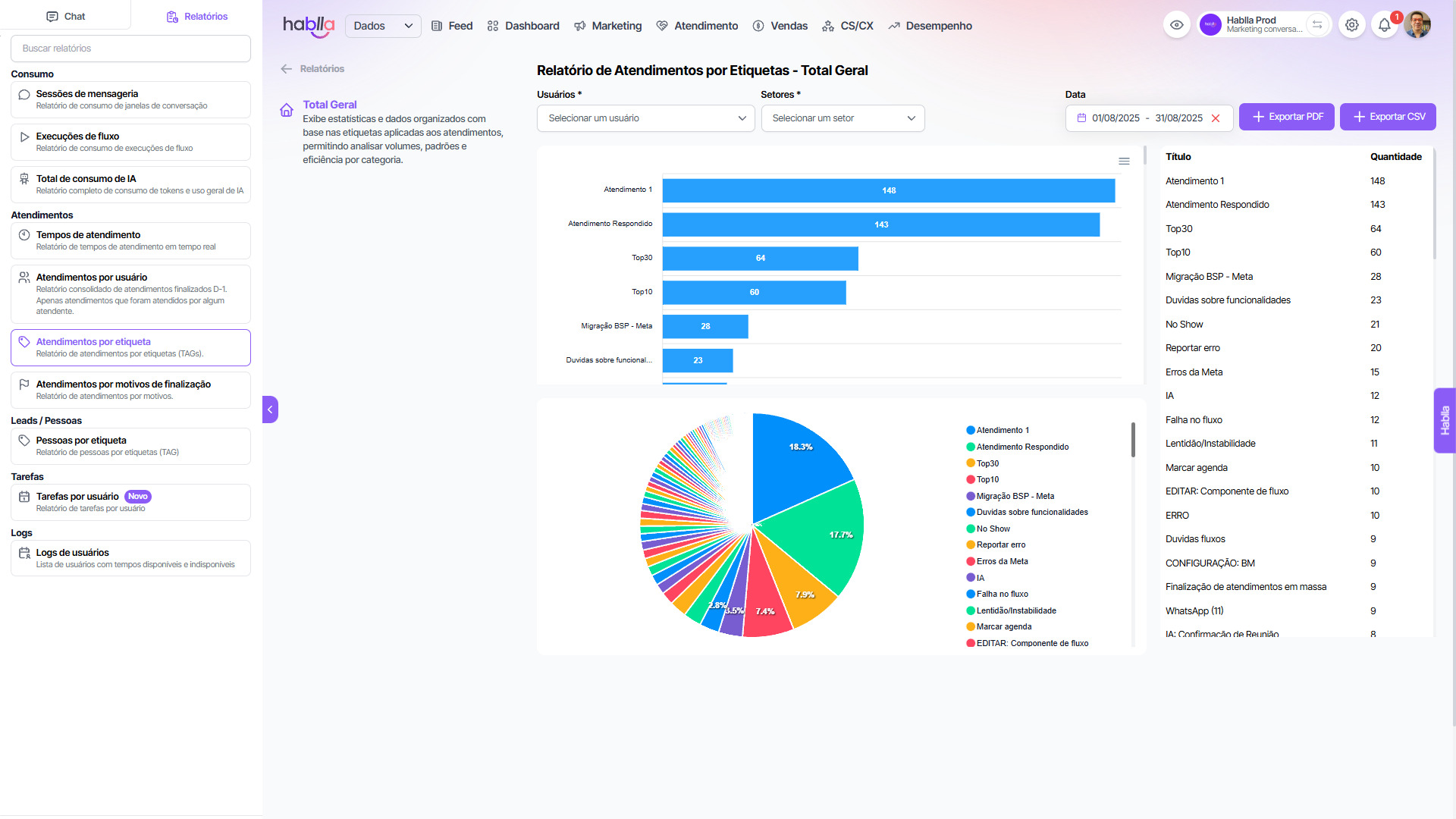
Le rapport de **Assistances par étiquette** organise et analyse les assistances à partir des TAGs appliquées, offrant une vision claire des demandes les plus récurrentes, des schémas d'utilisation et des domaines nécessitant une attention stratégique accrue.
Principales fonctionnalités et avantages :
* **Répartition par TAGs** : permet d'identifier quels sujets concentrent le plus grand volume d'assistances, comme des questions fonctionnelles, des erreurs de flux, des migrations ou des questions opérationnelles.
* **Vision de priorisation** : en comprenant les catégories les plus fréquentes, il devient possible d'orienter des améliorations dans les automatisations, la formation de l'équipe ou même des ajustements produit.
* **Analyse comparative par utilisateurs et secteurs** : permet de filtrer et de comprendre quelles zones de l'organisation sont le plus impactées par certains types d'assistance.
* **Cartographie de l'efficacité** : en surveillant des TAGs telles que « erreur », « no show » ou « finalisation en masse », les gestionnaires peuvent détecter des goulots d'étranglement, mettre en œuvre des plans d'action et améliorer la qualité de l'expérience client.
Ce rapport fonctionne comme un **thermomètre des thèmes critiques** , permettant d'aligner la priorisation interne sur la base de données réelles d'interaction.
---
# Agent Instructions
This documentation is published with GitBook. GitBook is the documentation platform designed so that both humans and AI agents can read, navigate, and reason over technical content effectively. Learn more at gitbook.com.
## Querying This Documentation
If you need additional information that is not directly available in this page, you can query the documentation by asking a question.
Perform an HTTP GET request on the following URL with the `ask` and `goal` query parameters:
```
GET https://docs.hablla.com/french/rapports/rapports-et-journaux-de-hablla/prises-en-charge-par-etiquette.md?ask=&goal=
```
`ask` is the immediate question: it should be specific, self-contained, and written in natural language.
`goal` is what the user is ultimately trying to achieve, the reason they need the answer. Sharing it helps GitBook give you a better, more relevant answer. A goal is most helpful when it describes the outcome the user wants rather than restating the question. For example, with `ask=how do I create an API token`, a goal like `automate deployments from our CI pipeline` lets GitBook tailor the answer to that use case.
The response will contain a direct answer to the question and relevant excerpts and sources from the documentation.
Use this mechanism when the answer is not explicitly present in the current page, you need clarification or additional context, or you want to retrieve related documentation sections.