> For the complete documentation index, see [llms.txt](https://docs.hablla.com/llms.txt). Markdown versions of documentation pages are available by appending `.md` to page URLs; this page is available as [Markdown](https://docs.hablla.com/hablla-docs-en/hablla/settings/connections-and-integrations/whatsapp/whatsapp-window-reports.md).
# WhatsApp Window Reports
Export WhatsApp reports in Hablla as CSV, XLSX, or JSON. Analyze campaigns, integrate data into BI, and keep organized records for audits.
Hablla allows you to track the performance of messages sent by the **Official WhatsApp** through detailed reports.\
These reports help you understand the performance of campaigns, transactional messages, and service flows, as well as allowing analyses by custom filters.
***
### WhatsApp Reports
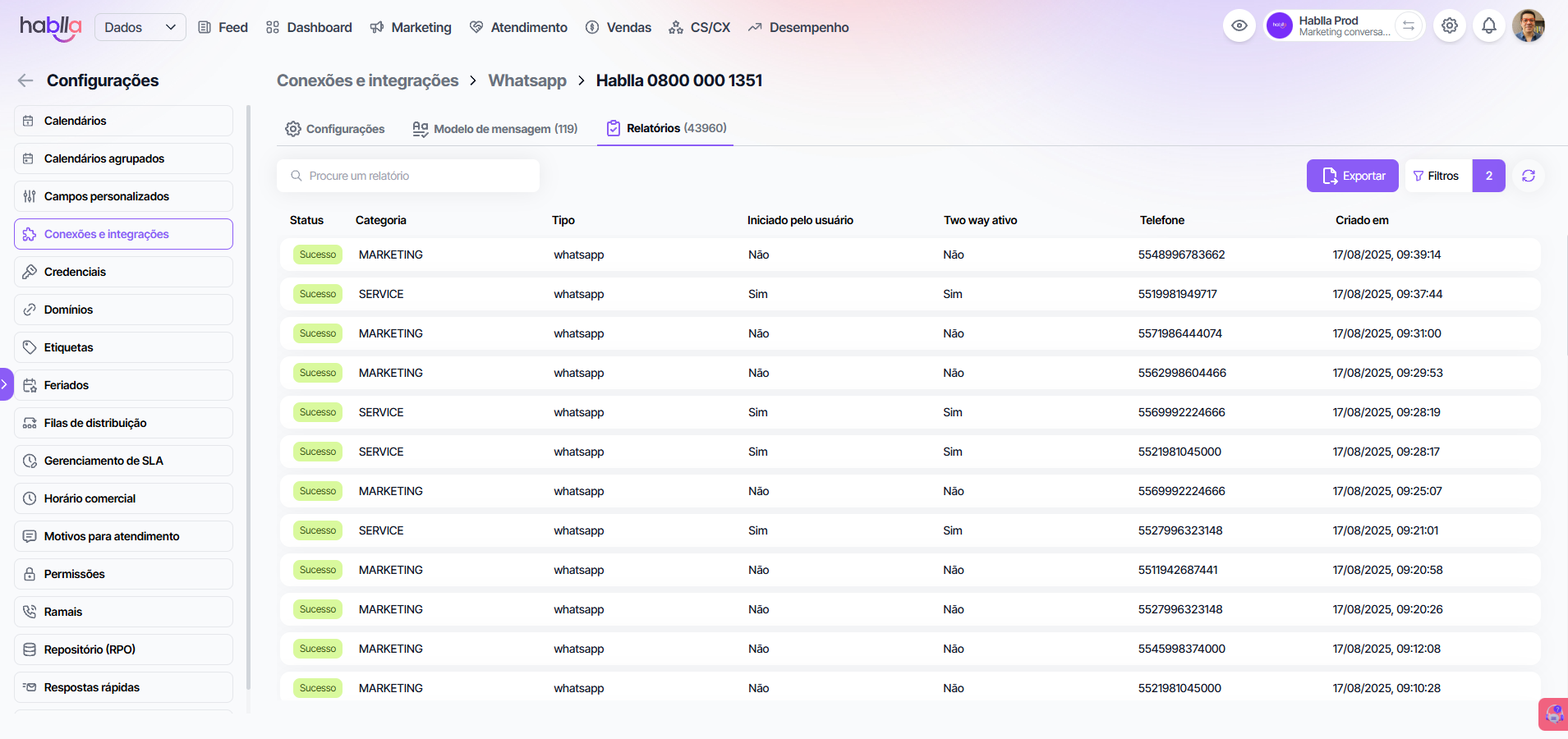
In the **Reports**, you will find a complete history of the messages sent by your company on WhatsApp.
The main information displayed includes:
* **Status**: indicates whether the message was delivered successfully or if there was an error.
* **Category**: Marketing, Utility (Services), Authentication, Service, or Reference.
* **Type**: channel used (e.g., WhatsApp).
* **Initiated by**: shows whether the message was initiated by the user or the customer.
* **Two Way enabled**: indicates whether the conversation was open for two-way interaction.
* **Phone**: customer's number that received the message.
* **Sent date**: record of when the message was created and sent.
These reports can be **exported** for external analysis and integrated into your BI process.
***
### Custom Filters
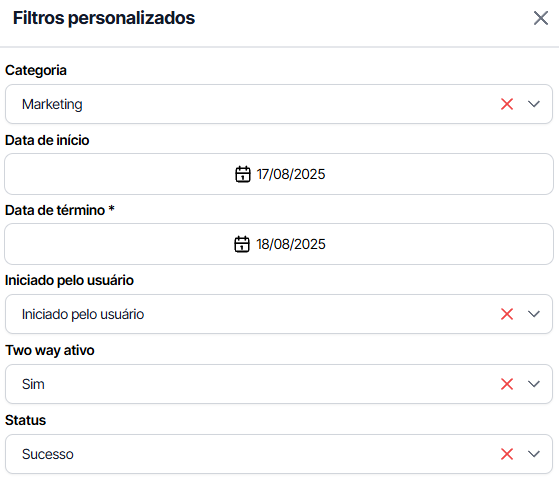
To refine your analysis, you can apply filters that allow you to view only the relevant data.
The available filters include:
* **Category**: select the template category (Authentication, Utility, Marketing, Service, or Reference).
* **Start and end date**: define a specific period for analysis.
* **Initiated by**: choose between messages initiated by the **user** or by the **customer**.
* **Two Way enabled**: filter messages where two-way interaction was enabled (Yes/No).
* **Status**: view only messages with **Success** or **Error**.
By combining filters, for example, you can:
* Analyze only messages **marketing** sent in the last month.
* Check messages **authentication** with error status.
* Evaluate **customer-initiated interactions** in specific campaigns.
## WhatsApp Report Export
Hablla allows **exporting WhatsApp message reports** in different file formats.\
This function is ideal for external analyses, integrations with BI systems, or storage for audits.
> ⚠️ Export respects the filters applied in the report. Always set the period, category, and status before exporting.
***
### How to export reports
1. Go to **Settings → Connections and integrations → WhatsApp**.
2. Click the tab **Reports**.
3. Apply filters (category, date, status, message origin, etc.) if necessary.
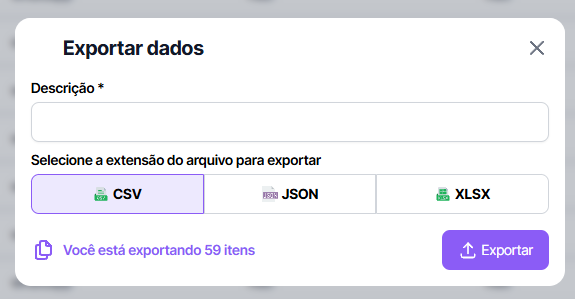
4. Click **Export**.
5. Choose the desired format: **CSV, XLSX, or JSON**.
***
### Available formats
#### 📄 CSV
* Compatible with Excel, Google Sheets, and LibreOffice.
* Simple structure of columns and rows separated by comma.
* Great for quick manipulation and tabular analysis.
**Usage example**: marketing teams analyzing bulk sends.
***
#### 🗂 XLSX
* Native file from **Microsoft Excel**.
* Keeps columns organized for use of filters, formulas, and pivot tables.
* Ideal for visual reports and sharing with non-technical teams.
**Usage example**: performance reports presented to management.
***
#### 🔧 JSON
* Structure in **key/value**, ideal for integrations with APIs or Data Warehouses.
* Technical format, recommended for developers and BI analysts.
**Usage example**: import data into internal systems or analysis tools.
***
### Downloading Reports
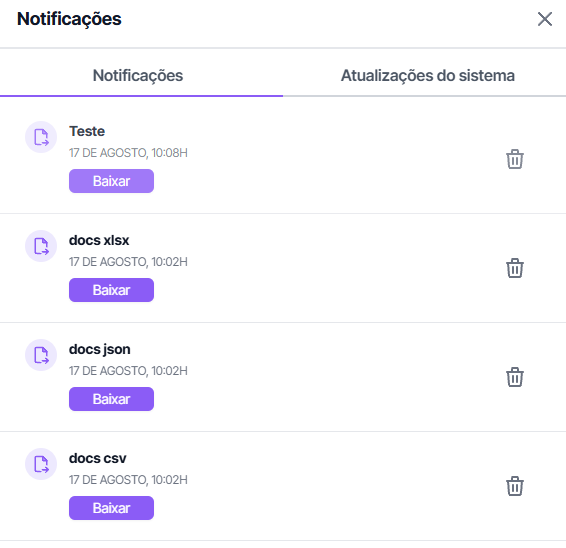
Whenever you export a report in Hablla, it will be available in the notifications tab (bell icon), next to the profile picture. Depending on the size, it may take a few minutes to become available for download.
### Best practices
* Always apply filters before exporting to reduce the data volume.
* For large datasets, prefer **CSV** (lighter) or **XLSX** (more organized).
* Use **JSON** only in technical integration contexts.
***
### Summary
WhatsApp report export in Hablla ensures flexibility and adaptability.
* **CSV/XLSX** → operational analyses and sharing.
* **JSON** → technical integrations and automations.
📌 **Practical tip**: set up an export routine to track results periodically and centralize data in your BI.
***
### Usage examples
* **Marketing Team**: validate the success rate in promotional campaigns.
* **Technical Support**: analyze errors in transactional messages (Utility).
* **CX Management**: track which contacts were initiated by the customer and generated new opportunities.
***
### Summary
The WhatsApp reports in Hablla offer a complete view of the performance of sent, delivered, and responded messages.\
With custom filters, it is possible to turn raw data into **actionable insights**, improving campaigns, service, and operations.
***
📌 **Practical tip**: export reports with applied filters to cross-reference the data with other analysis tools (such as BI or spreadsheets).
**ℹ️ Note:** This documentation covers only how the feature works. For information about billing, costs, or commercial terms, consult the current contract or contact the responsible department.
---
# Agent Instructions
This documentation is published with GitBook. GitBook is the documentation platform designed so that both humans and AI agents can read, navigate, and reason over technical content effectively. Learn more at gitbook.com.
## Querying This Documentation
If you need additional information that is not directly available in this page, you can query the documentation dynamically by asking a question.
Perform an HTTP GET request on the current page URL with the `ask` query parameter, and the optional `goal` query parameter:
```
GET https://docs.hablla.com/hablla-docs-en/hablla/settings/connections-and-integrations/whatsapp/whatsapp-window-reports.md?ask=&goal=
```
`ask` is the immediate question: it should be specific, self-contained, and written in natural language.
`goal` is optional and describes the broader end goal you are ultimately trying to accomplish on behalf of the user. GitBook uses it to tailor the answer towards what is most useful for that goal.
The response will contain a direct answer to the question and relevant excerpts and sources from the documentation.
Use this mechanism when the answer is not explicitly present in the current page, you need clarification or additional context, or you want to retrieve related documentation sections.