> For the complete documentation index, see [llms.txt](https://docs.hablla.com/llms.txt). Markdown versions of documentation pages are available by appending `.md` to page URLs; this page is available as [Markdown](https://docs.hablla.com/hablla-docs-en/reports/hablla-reports-and-logs/interactions-by-closing-reason.md).
# Interactions by closing reason
Report of interactions by reason.
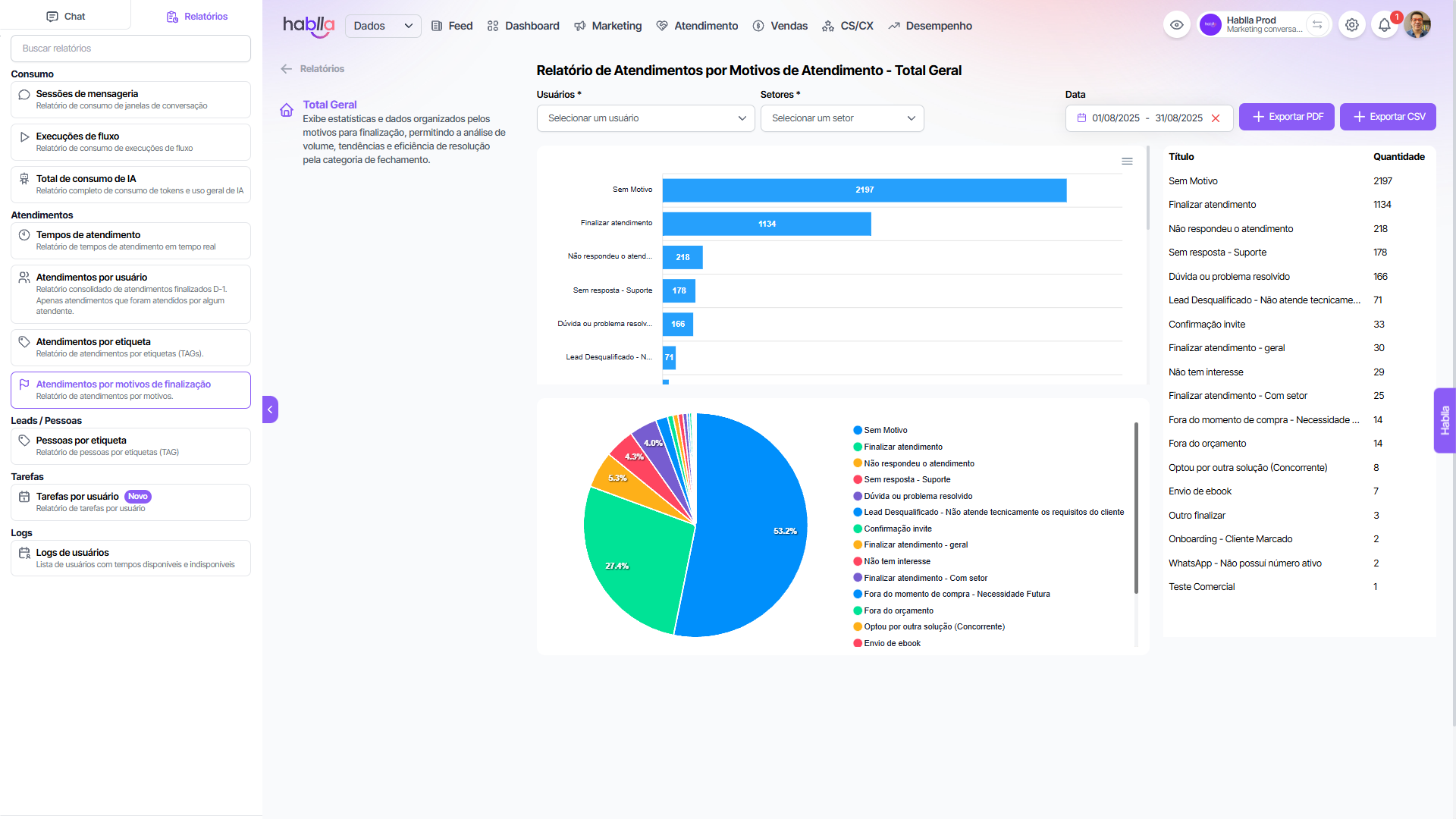
#### Service Interactions by Closing Reasons
The report of **Service Interactions by Closing Reasons** details the closures of interactions based on the selected reasons, offering a clear view of quality, effectiveness, and the main friction or success points in the service.
Main features and benefits:
* **Reason mapping**: identifies why interactions were closed, from satisfactory conclusions to dropouts or unresponsive contacts.
* **Efficiency management**: by monitoring closures by category (e.g.: problem solved, no response, not interested, chose another solution), leaders can measure service accuracy and the alignment of interactions with the final objective.
* **Gap detection**: recurring reasons such as “No response” or “Disqualified lead” signal opportunities for improvement in engagement, qualification, and follow-up processes.
* **Predictive churn analysis**: reasons like “chose a competitor” or “not the right time to buy” act as early indicators of lost opportunities, enabling smarter reactivation strategies.
* **Customer experience enhancement**: by tracking positive closing reasons (“question resolved”, “invite confirmed”), it is possible to reinforce successful practices and replicate them across the operation.
This report is essential to turn closing data into **strategic retention and conversion intelligence**, supporting both **CX** and **Revenue Operations**.
---
# Agent Instructions
This documentation is published with GitBook. GitBook is the documentation platform designed so that both humans and AI agents can read, navigate, and reason over technical content effectively. Learn more at gitbook.com.
## Querying This Documentation
If you need additional information that is not directly available in this page, you can query the documentation by asking a question.
Perform an HTTP GET request on the following URL with the `ask` and `goal` query parameters:
```
GET https://docs.hablla.com/hablla-docs-en/reports/hablla-reports-and-logs/interactions-by-closing-reason.md?ask=&goal=
```
`ask` is the immediate question: it should be specific, self-contained, and written in natural language.
`goal` is what the user is ultimately trying to achieve, the reason they need the answer. Sharing it helps GitBook give you a better, more relevant answer. A goal is most helpful when it describes the outcome the user wants rather than restating the question. For example, with `ask=how do I create an API token`, a goal like `automate deployments from our CI pipeline` lets GitBook tailor the answer to that use case.
The response will contain a direct answer to the question and relevant excerpts and sources from the documentation.
Use this mechanism when the answer is not explicitly present in the current page, you need clarification or additional context, or you want to retrieve related documentation sections.